Tata Power Rooftop Solar Additions Rise 50% in H1 FY27
POWER & RENEWABLE ENERGY

Tata Power Rooftop Solar Additions Rise 50% in H1 FY27

Tata Power Renewable Energy added more than 168,530 rooftop solar installations in the first half of FY27, recording a 50 per cent year-on-year increase. Uttar Pradesh, Maharashtra, Rajasthan and Kerala were the leading markets during the six-month period ended September 2026.

Uttar Pradesh led the installation drive with 44,014 systems, adding around 172 MWp of capacity. Maharashtra followed with 22,165 installations and nearly 100 MWp, while Rajasthan recorded 21,275 installations contributing 99 MWp. Kerala added 15,477 installations with around 65 MWp of capacity.

Tata Power Solaroof, the rooftop solar division of Tata Power Renewable Energy (TPREL), added 801 MWp of capacity during H1 FY27, up 25 per cent from 639 MWp in the corresponding period of FY26. The company added 88,397 installations in the July-September quarter, a 33 per cent increase from 66,447 installations in Q2 FY26, while quarterly capacity additions rose 15 per cent to 426 MWp from 369 MWp.

The latest additions took TPREL’s cumulative rooftop solar installations to 575,000, with total installed capacity crossing 5.67 GWp nationwide. The portfolio covers residential, commercial and industrial segments, reflecting the company’s presence across multiple customer categories.

Maharashtra has the highest cumulative capacity among the key states, with 73,578 installations aggregating 1,041 MWp. Uttar Pradesh has recorded 116,254 cumulative installations with 528 MWp, while Kerala has contributed 69,734 installations with more than 310 MWp. Rajasthan has recorded 44,798 installations and cumulative capacity of 390 MWp, supporting broader rooftop solar adoption across residential and commercial and industrial markets.

Tata Power Renewable Energy added more than 168,530 rooftop solar installations in the first half of FY27, recording a 50 per cent year-on-year increase. Uttar Pradesh, Maharashtra, Rajasthan and Kerala were the leading markets during the six-month period ended September 2026. Uttar Pradesh led the installation drive with 44,014 systems, adding around 172 MWp of capacity. Maharashtra followed with 22,165 installations and nearly 100 MWp, while Rajasthan recorded 21,275 installations contributing 99 MWp. Kerala added 15,477 installations with around 65 MWp of capacity. Tata Power Solaroof, the rooftop solar division of Tata Power Renewable Energy (TPREL), added 801 MWp of capacity during H1 FY27, up 25 per cent from 639 MWp in the corresponding period of FY26. The company added 88,397 installations in the July-September quarter, a 33 per cent increase from 66,447 installations in Q2 FY26, while quarterly capacity additions rose 15 per cent to 426 MWp from 369 MWp. The latest additions took TPREL’s cumulative rooftop solar installations to 575,000, with total installed capacity crossing 5.67 GWp nationwide. The portfolio covers residential, commercial and industrial segments, reflecting the company’s presence across multiple customer categories. Maharashtra has the highest cumulative capacity among the key states, with 73,578 installations aggregating 1,041 MWp. Uttar Pradesh has recorded 116,254 cumulative installations with 528 MWp, while Kerala has contributed 69,734 installations with more than 310 MWp. Rajasthan has recorded 44,798 installations and cumulative capacity of 390 MWp, supporting broader rooftop solar adoption across residential and commercial and industrial markets.

Related Stories

Gold Stories

Next Story
Real Estate

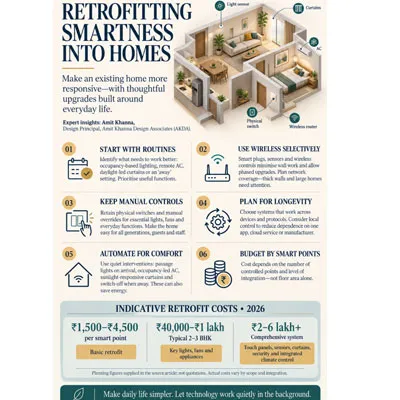
Born Smart or Built Smart?

In residential projects where the homeowner has a clear requirement for extensive automation, the smart-home brief should influence the design from the outset. CW explores exactly how such mandates influence design-development. QUICK BYTESIntegrate smart technology with architecture, interiors and MEP from the outset.Let residents’ needs and routines guide automation.Integrate sensors, wiring and controls without compromising design.Build flexible infrastructure for evolving technologies.Smart systems should be simple, reliable and easy to use.Existing homes can be retrofitted with mini..

Next Story
Technology

Move Less, Build More

On high-rise sites in Mumbai, until a few years ago, the common material handling solution was manpower and the repeated relocation of material until it finally reached the floor where it was to be installed.Cut to today. “Now, we are adopting automation in material handling, not to replace people but to reduce unnecessary movement, improve planning, and use people and equipment more efficiently,” says Raahul Maroo, Founder & Managing Director, Tat:vm Builders and Developers.To read the full article Click Here ..

Next Story
Infrastructure Urban

Law and Order

In modern economies, construction projects serve as a catalyst for economic growth and national development. In India, the construction industry plays a vital role in infrastructure development, urbanisation and employment generation. However, these projects involve significant financial, contractual, legal, environmental and safety risks, necessitating an effective legal framework to regulate their execution.The India perspectiveConstruction projects are governed by various legal and regulatory requirements relating to land acquisition, planning permissions, labour welfare, environmental clea..

Advertisement

Subscribe to Our Newsletter

Get daily newsletters around different themes from Construction world.

STAY CONNECTED

Advertisement

SPECIAL OFFER
QR Code