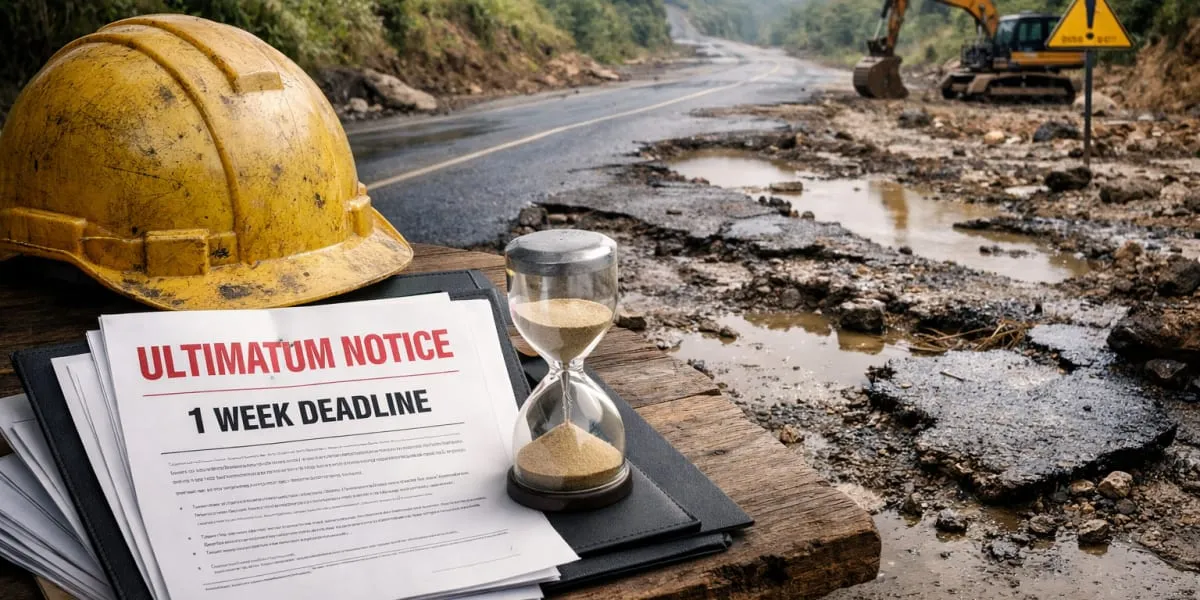
There is a saying that everyone in the construction industry is dishonest, which is a wrong perception

COAL & MINING

There is a saying that everyone in the construction industry is dishonest, which is a wrong perception

FY19 was a challenging time for India Inc. The issues were many, ranging from liquidity crunch, rising bad loans, loan defaults (principal as well as interest), slowing capex and slower automobile growth to delayed or stalled projects, financially inviable projects and an insolvency-like situation for a few large organisations. Despite all the obstacles, uncertainties and challenges, a few entities managed to persevere and prevail, posting growth and exhibiting excellence. And these are the companies, from the universe of construction, contracting, engineering and building materials, many of whom were awarded and honoured for their outstanding work at the India Construction Festival in Delhi.

The India Construction Festival, organised by FIRST Construction Council on October 15 and 16, 2019, comprised four sub-events: The India Roads Conference; CONSTRUCTION WORLD Global Awards; CONSTRUCTION WORLD Leadership Summit; and the EQUIPMENT INDIA Awards.

Here’s a glimpse of what Anil Swarup, Former Secretary, Government of India, had to say at the Festival:

“It’s important for to understand how you engage with the Government and what you do with the Government. 

When I took over at the coal ministry, everyone thought that scams were a problem. And two scams had already broken out. When I analysed it, I realised that scams were just a symptom of a problem, of a much deeper problem. We discovered that the primary problem of coal scams was shortage of coal. Imagine, India sits on 300 billion tonne of coal reserves and we require only 800 billion for our need. There is demand and there is supply, yet we are short of coal. Then we tried to decide why there is a shortage of coal if so much coal is supplied. So for getting coal, there are three important ingredients: Availability of land, environment and forest clearance, and evacuation of coal. 

When I say approach the Government, the last point I want to mention is that sometimes the Government does not analyse the problem to identify where the problem is. There is a saying that everyone in the construction industry is dishonest, which is a wrong perception. So, how will it be corrected? My advice to the Government is to set up an empowered group that goes into the detail of each project to identify whether the problem is with the promoter. So, for example, if the Government does not give the environmental clearance or provide land, how do you hold the construction industry responsible for constructing that road? In another instance, there could be a case that the Government has provided these clearances, the land has been provided and the contractor does not construct for whatever reasons; but this can happen only if you go into the details of it. Unfortunately, no one has time for the details because details don’t get publicised. 

I remember when I was the coal secretary, I would say let’s do the walking and let someone else do the talking. But I discovered post retirement that the easiest thing on earth to do is to talk. 

When I was heading the Project Monitoring Group (PMG), when we were trying to fast-track projects worth Rs 10 billion, it did happen. In UPA, too, we did manage to clear projects worth Rs 5 trillion in 15 months. So it can happen; you must understand how it will happen. The PMG still exists. How about creating institutional track platforms to re-establish the communication between the one who has the problem and the one who is creating the problem? Sometimes, it can be magical. It is wrong to assume that people on the other hand do not want a solution to the problem. To me, it’s more of a communication problem than anything else.”


FY19 was a challenging time for India Inc. The issues were many, ranging from liquidity crunch, rising bad loans, loan defaults (principal as well as interest), slowing capex and slower automobile growth to delayed or stalled projects, financially inviable projects and an insolvency-like situation for a few large organisations. Despite all the obstacles, uncertainties and challenges, a few entities managed to persevere and prevail, posting growth and exhibiting excellence. And these are the companies, from the universe of construction, contracting, engineering and building materials, many of whom were awarded and honoured for their outstanding work at the India Construction Festival in Delhi.The India Construction Festival, organised by FIRST Construction Council on October 15 and 16, 2019, comprised four sub-events: The India Roads Conference; CONSTRUCTION WORLD Global Awards; CONSTRUCTION WORLD Leadership Summit; and the EQUIPMENT INDIA Awards.Here’s a glimpse of what Anil Swarup, Former Secretary, Government of India, had to say at the Festival:“It’s important for to understand how you engage with the Government and what you do with the Government. When I took over at the coal ministry, everyone thought that scams were a problem. And two scams had already broken out. When I analysed it, I realised that scams were just a symptom of a problem, of a much deeper problem. We discovered that the primary problem of coal scams was shortage of coal. Imagine, India sits on 300 billion tonne of coal reserves and we require only 800 billion for our need. There is demand and there is supply, yet we are short of coal. Then we tried to decide why there is a shortage of coal if so much coal is supplied. So for getting coal, there are three important ingredients: Availability of land, environment and forest clearance, and evacuation of coal. When I say approach the Government, the last point I want to mention is that sometimes the Government does not analyse the problem to identify where the problem is. There is a saying that everyone in the construction industry is dishonest, which is a wrong perception. So, how will it be corrected? My advice to the Government is to set up an empowered group that goes into the detail of each project to identify whether the problem is with the promoter. So, for example, if the Government does not give the environmental clearance or provide land, how do you hold the construction industry responsible for constructing that road? In another instance, there could be a case that the Government has provided these clearances, the land has been provided and the contractor does not construct for whatever reasons; but this can happen only if you go into the details of it. Unfortunately, no one has time for the details because details don’t get publicised. I remember when I was the coal secretary, I would say let’s do the walking and let someone else do the talking. But I discovered post retirement that the easiest thing on earth to do is to talk. When I was heading the Project Monitoring Group (PMG), when we were trying to fast-track projects worth Rs 10 billion, it did happen. In UPA, too, we did manage to clear projects worth Rs 5 trillion in 15 months. So it can happen; you must understand how it will happen. The PMG still exists. How about creating institutional track platforms to re-establish the communication between the one who has the problem and the one who is creating the problem? Sometimes, it can be magical. It is wrong to assume that people on the other hand do not want a solution to the problem. To me, it’s more of a communication problem than anything else.”

Next Story
Real Estate

RBI Rate Cut Boosts Confidence Across Housing Market

Industry Context and Market DynamicsThe real estate industry has welcomed the RBI’s rate cut as a timely boost to affordability and demand. With home prices having risen steadily across major markets, even a marginal reduction in interest rates meaningfully strengthens purchasing power, especially for first-time and mid-income buyers.Ashish Jerath, President – Sales & Marketing, Smartworld Developers, observes:“The RBI’s 25-basis-point cut, bringing the repo rate down to 5.25%, is a timely boost for the real estate sector. Lower interest rates reduce borrowing costs, enabling homeb..

Next Story
Infrastructure Transport

BMC Resumes Rs 170 Billion Road Works, Targets 80 per cent By Jan 2026

Following the withdrawal of the southwest monsoon in October, the Brihanmumbai Municipal Corporation (BMC) has restarted work on 645 roads—covering 297.49 kilometres—under its large-scale concretisation programme. Data shows that more than 60 per cent of the resumed works are located in the western suburbs. Officials said the civic body aims to complete concretisation on 80 per cent of the roads where fresh work has begun by January 2026. Launched in 2022, the Rs 170 billion project seeks to concretise 700 kilometres of roads across Mumbai. All civil works were halted during the monsoon ..

Next Story
Infrastructure Urban

India Pushes Digital Shift In Urban Land Mapping

The Department of Land Resources (DoLR) under the Ministry of Rural Development has convened a National Symposium on NAKSHA – the National Geospatial Knowledge-based Land Survey of Urban Habitations – to advance India’s transition to modern, technology-driven land mapping. Speaking at the inaugural session, Secretary Manoj Joshi underscored the urgent need to move revenue departments away from outdated, tape-based methods and rough hand-drawn sketches. He stressed that adopting latitude–longitude-based digital mapping and GIS-linked registration systems is essential for economic stabi..

Advertisement

Subscribe to Our Newsletter

Get daily newsletters around different themes from Construction world.

STAY CONNECTED

Advertisement

Advertisement

Advertisement

Advertisement

Open In App